1.1 Introduction
The Ministry of Health carries on, by means of the Department of Science and Technology - Decit, with its purpose of meeting the health needs of the population, as expressed in the National Health Policy. Concerning those needs, the research may contribute for achieving integrality, equity and solvability of the Brazilian Unified Health System (Sistema Único de Saúde – SUS).
The many steps of the process of defining the National
Agenda of Priority Research in Health (Agenda Nacional
de Prioridades de Pesquisa em Saúde – ANPPS)
and laying out the National Policy on Science, Technology
and Innovation in Health (Política Nacional de
Ciência, Tecnologia e Inovação em Saúde
– PNCTIS), having been intensified in the 2003-2004
period, resulted in symbolic milestones for the developed
fomentation actions. Those two tools, which were conceived
and implemented based on a broad and systematized debate
among managers, researchers, users, health workers and representatives
of the society, have allowed the publishing of 22 calls
for bid concerning health research in various knowledge
areas and funding for 1,210 studies between 2004 and 2005,
thus placing the Ministry of Health among the undertakers
of national efforts for health research.
The logic for laying out calls for bid follows the subjects
pointed out in the PNCTIS. This goes way beyond listing
diseases and conditions and considers, in special, the needs
for policy improvement studies, existent knowledge gaps,
and availability of financial resources.
In order to improve the process of board definition and
to broaden the levels of debate among managers, users and
researchers, Decit has sought tools in national and international
experiments for improving the priority-setting process in
health research, in a partnership with the technical areas
in the Ministry of Health and in the National Council for
Scientific and Technological Development (Conselho Nacional
de Pesquisa – CNPq).
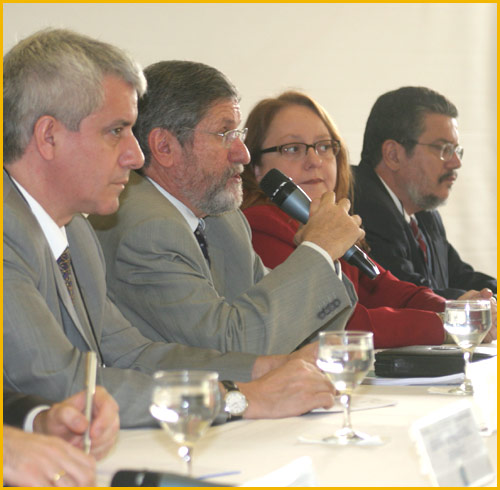
With that purpose, the Workshop of Research Priorities
in Health was held, bringing together representatives from
all those segments. It took place in Brasília, at
the Academia de Tênis on March 08-09, 2006.
In order to collaborate for improving the methodology,
Professor Andrés de Francisco was invited, who is
a representative of the Global Forum For Health Research.
This foundation has remarkable experience in using the Combined
Approach Matrix (CAM) for setting research priorities in
health, specially the five-step process of the WHO ad hoc
committee for prioritization.
The workshop discussed research priorities in the areas
of Health Communication and Information; Work Management;
Education Management; Health Technology Assessment; Diagnostic
Kits; Clinical Genetics; Health and Environment; Health
of the Afro-Brazilian Population; Health of People with
Disabilities; Populational Aging and Health of the Elderly
Person; Health of the Male Population; Social Determinants
and Medications.
The composition and topics of round tables aimed to hold
debates for subsidizing group works, with the participation
of: directors, managers, representatives from the National
Council of Health Secretaries (Conselho Nacional de
Secretários da Saúde – CONASS)
and from the National Council of Municipal Health Secretaries
(Conselho Nacional de Secretários Municipais da Saúde
– CONASEMS), researchers and an international guest,
who has experience in the application of the selected methodology.
It is worth remarking that the areas of Health and Environment;
Populational Aging and Health of the Elderly Person; Social
Determinants; and Diagnostic Kits have participated only
in the final Plenary Session of the event, with the objective
of presenting the Research Priorities already defined in
previous discussions.
In order to discuss the subject Neglected Diseases, which
is also target of public attention, the workshop Research
Priority and Innovation for Neglected Diseases was held
in Rio de Janeiro, on April 5-7, 2006. The initiative counted
on the valuable technical cooperation from the Center for
Technological Development in Health (Centro de Desenvolvimento
Tecnológico em Saúde – CDTS), of
the Oswaldo Cruz Foundation (Fundação
Oswaldo Cruz – FIOCRUZ), under the coordination
of Professor Carlos Morel and with the partnership with
CNPq. For that first discussion, they approached Malaria,
Chagas disease, Leishmaniasis, Dengue Fever, Tuberculosis
and Hansen’s disease.
The process will be described and recorded in full, since
it constitutes an important learning for all agents involved,
thus providing an information source for publicizing and
qualitative assessment of the fomentation initiatives coordinated
by the Ministry of Health by means of Decit.
|